Tada Hiroshi Shihan — Aikidō, Ki, and the Gessō-ji Tradition

Tada Hiroshi (多田 宏, born 14 December 1929 in Tokyo) is a Japanese aikidō teacher holding the rank of 9th dan in the Aikikai. Born into a former samurai family from Tsushima Island, he first studied his family’s archery style (Heki-ryū Chikurin-ha Ban-pa) under his father before entering Waseda University, where he joined the karate club. In March 1950, while still a law student at Waseda, he began training in aikidō at the Aikikai Hombu Dojo under the founder, Ueshiba Morihei (O-Sensei).
In the same year he was introduced to the Tempukai — the organisation founded by Nakamura Tempu — and immediately joined after hearing Tempu speak at the Gekkōden of Gokokuji Temple. This dual influence — the martial path of Ueshiba and the mind-body unification teachings of Tempu — shaped the core of Tada’s approach to aikidō: technique inseparable from breath, breath inseparable from awareness, awareness inseparable from ki.
After graduating in 1952, Tada dedicated himself fully to aikidō and the research of Japanese martial arts history. In 1964, the Aikikai dispatched him to Rome, where he established the Dojo Centrale Italiano (1967) and the national federation Aikikai d’Italia (1970). He returned to Japan in 1971 to resume teaching at Hombu Dojo. In 1976, following a meeting with Reverend Shōken Murao, he founded the Aikidō Gessō-ji Dōjō inside Gessō-ji Zen Temple in Musashino, Tokyo — a place where the practice of budō and Zen sit under one roof.
His published works include Aikidō ni ikiru (合気道に生きる — Living in Aikidō), co-published in Italian as Vivere nell’Aikidō by Aikikai d’Italia, reflecting the depth of his lifelong connection to the Italian aikidō community.
Ki no Renma — 氣の練磨 — Kinorenma Summer School, La Spezia
Ki no renma (氣の練磨, literally „forging and refining of ki“) is the intensive training programme developed by Tada Hiroshi Shihan integrating the breath and concentration practices of Nakamura Tempu’s Shin-shin-toitsu-dō with the technical and energetic body of aikidō. The programme is not simply physical conditioning but a systematic cultivation of the ki-body: breath coordination (kokyū), postural alignment (shisei), unified mental focus (mushin), and the experience of ki circulation through the body in motion and in stillness.
Since the 1970s, Tada Shihan has conducted annual Kinorenma summer schools in Italy, hosted by Aikikai d’Italia. The summer gathering at La Spezia (Liguria) is one of the most significant lineage events in European aikidō — drawing practitioners from across Italy and internationally to train directly under Tada Shihan or his senior students in an intensive multi-day format. The setting is intentional: the Ligurian coast, with its light and sea air, mirrors the quality of open, receptive awareness cultivated in the training itself.
The Kinorenma curriculum typically progresses through: ankoku tanden kokyū-hō (breathing in darkness and centre), standing and moving ki exercises derived from Tempu’s yoga integration, paired aikidō technique practice in which ki cultivation is the governing principle rather than physical force, and meditation periods supporting the integration of day’s practice. Practitioners report the experience as transformative — the technical level is advanced but the orientation is inward: the question is always whether ki is alive in the movement.
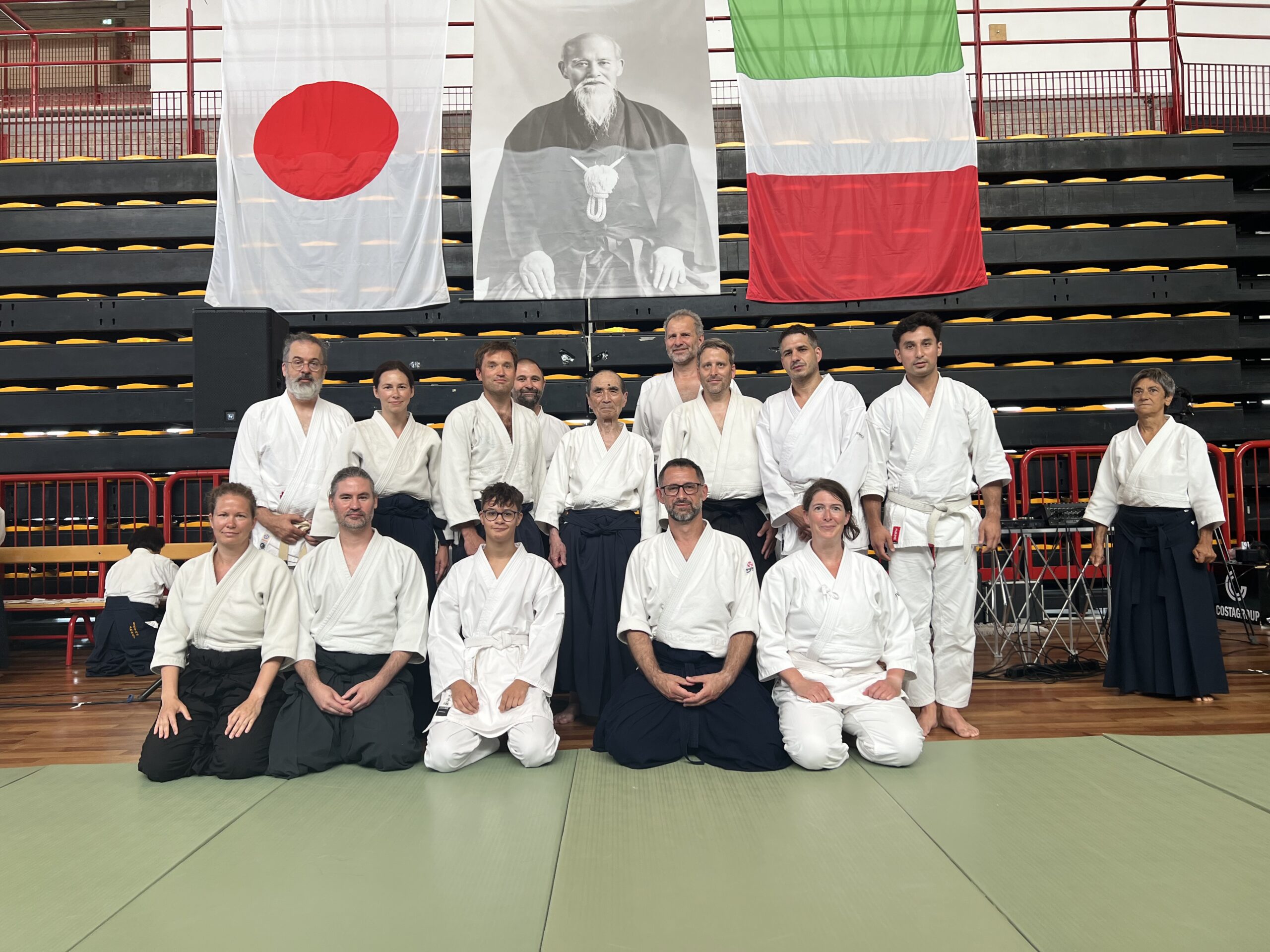
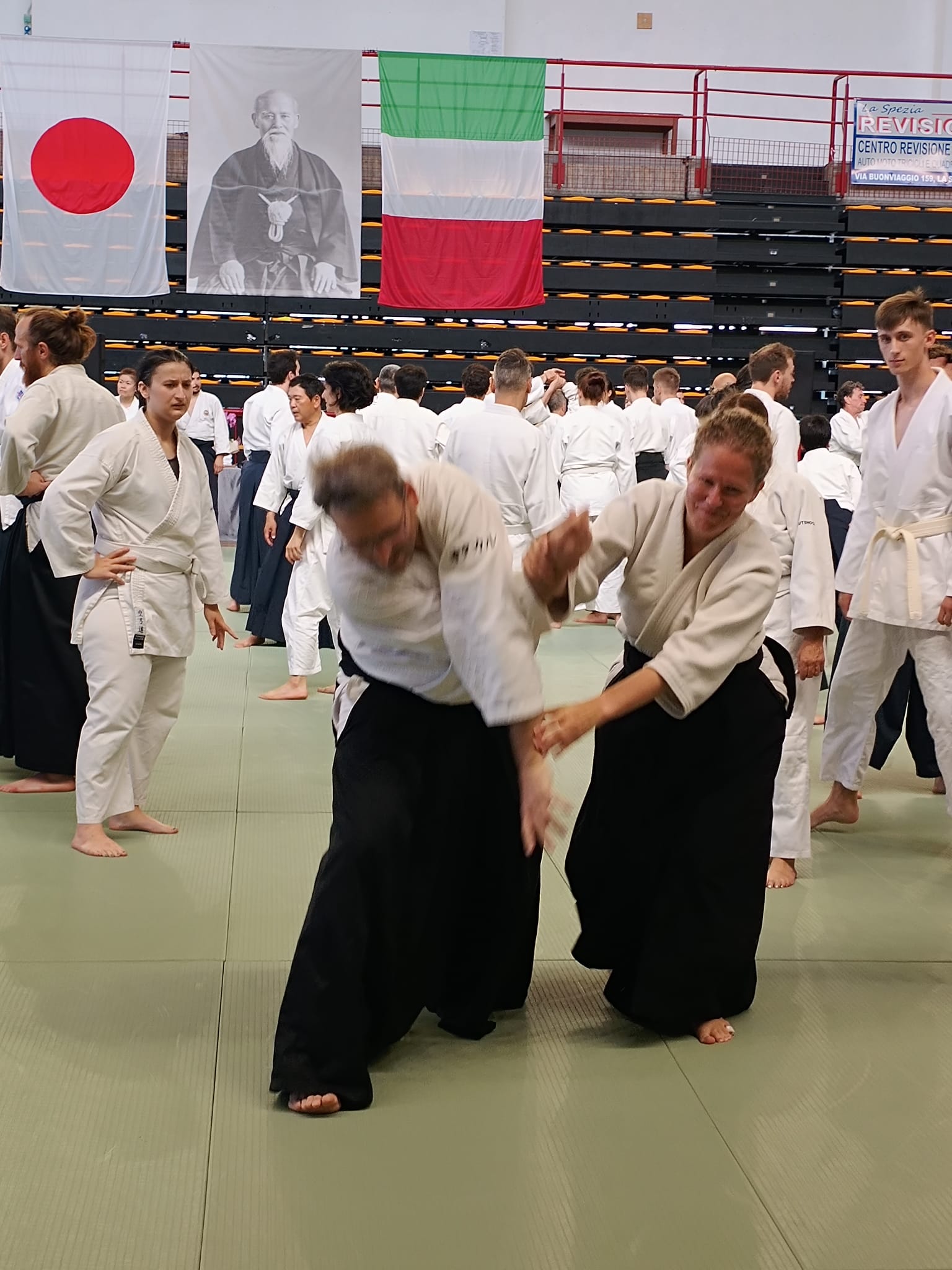
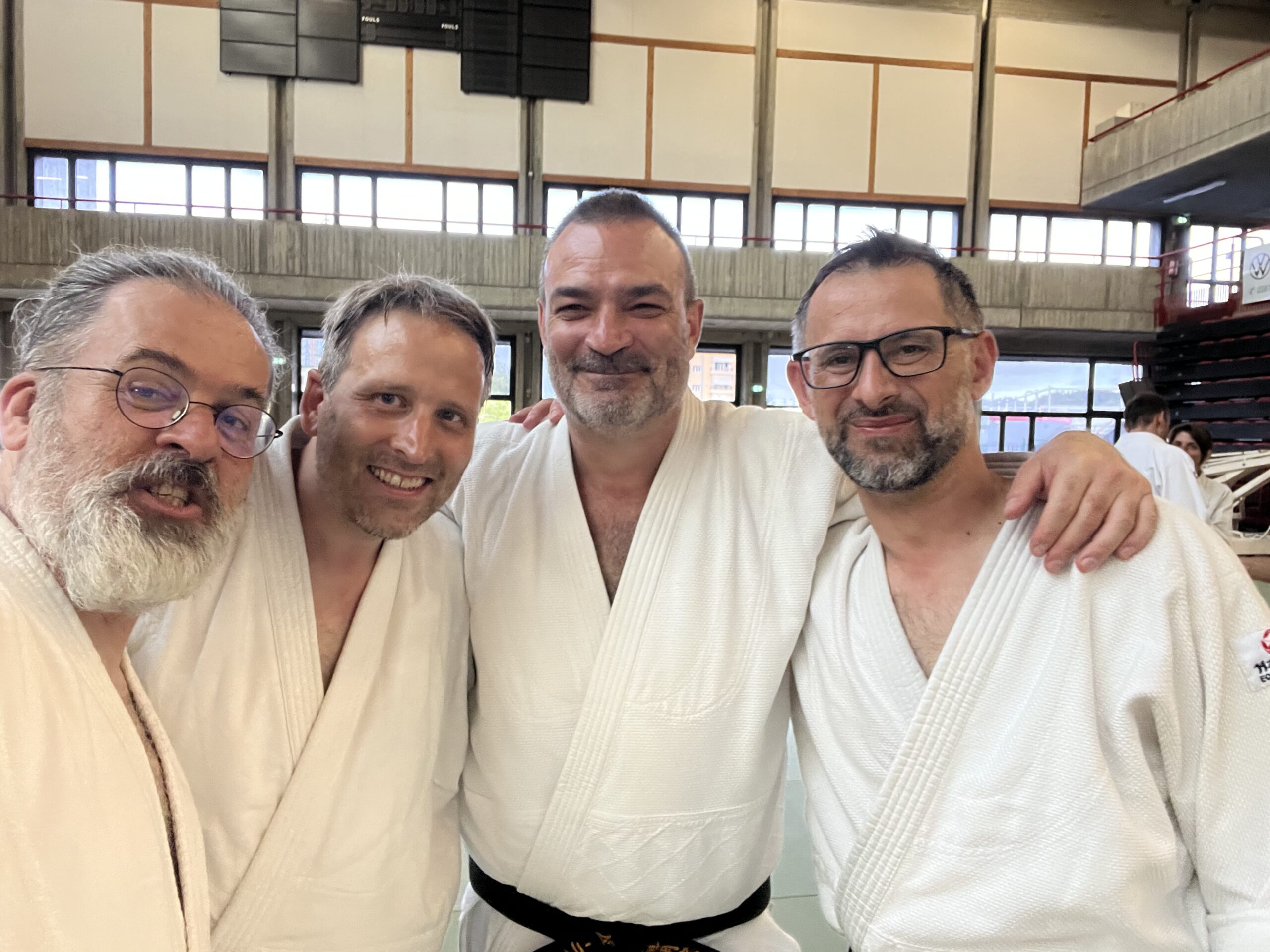

Photos: Kinorenma La Spezia seminar, Aikikai d’Italia. To update image paths, upload photos to wp-content/uploads/aikido/ or use WordPress Media Library and update src attributes in the editor.
O-Sensei Ueshiba Morihei — Founder of Aikidō
Ueshiba Morihei (植芝 盛平, 14 December 1883 — 26 April 1969), known reverently as O-Sensei, was born in Nishinotani village (now part of Tanabe city), Wakayama Prefecture. A sickly child, he was encouraged by his father to take up sumō and swimming. He studied several martial arts in his youth and served in the Russo-Japanese War. After discharge in 1907, he moved to Hokkaidō as head of a pioneer settlement, where he met and trained under Takeda Sōkaku, headmaster of Daitō-ryū Aiki-jūjutsu — the technical root from which aikidō would grow.
In 1919, Ueshiba joined the Ōmoto-kyō movement in Ayabe, where he served as martial arts instructor and opened his first dojo. He accompanied the Ōmoto-kyō leader Deguchi Onisaburō on a dangerous expedition to Mongolia in 1924. Back in Japan, a series of martial and spiritual experiences converged: in 1925, Ueshiba reported a revelation in which he felt bathed in golden light and perceived the fundamental unity of all creation. This vision became the philosophical cornerstone of aikidō — a martial art not of conquest but of harmonising with the energy of the universe.
Arriving in Tokyo in 1927, the Ueshiba family established the Kobukan dōjō (later the Aikikai Hombu Dojo) in Shinjuku. Ueshiba chose the name „Aikidō“ in 1942. During the war years, he retreated to Iwama, Ibaraki Prefecture, where he built the Aiki Shrine and refined his art into its mature form. The post-war period saw four generations of students carry aikidō across the world. O-Sensei died on 26 April 1969, leaving a legacy that continues through the Aikikai Foundation under the Ueshiba family.
Nakamura Tempu — The Way of Mind and Body Unification
Nakamura Tempu (中村 天風, 1876–1968) was a Japanese philosopher, healer, and martial artist who developed Shin-shin-toitsu-dō (心身統一道, The Way of Mind and Body Unification) — a system integrating Indian Raja Yoga, Japanese martial arts, Western medicine, and psychotherapy. A military intelligence officer in his youth, he contracted tuberculosis and embarked on a global quest for a cure. In the United States he studied medicine at Columbia University; in Europe he lived with the actress Sarah Bernhardt and researched psychology. In Egypt, a chance encounter with the Indian yogin Kaliapa led Tempu to Nepal, where years of austere training in meditation and Raja Yoga cured his illness and laid the foundation for his life’s teaching.
Back in Japan, Tempu taught for over fifty years. His system emphasises the unification of mind (shin) and body (shin), the cultivation of positive ki through breath and meditation, and the recognition that a concentrated, tranquil mind is the prerequisite for all effective action — whether in martial arts, healing, or daily life. His influence on Tada Hiroshi was decisive: the ki-breathing exercises (ki no renma) practised in Tada’s aikidō lineage descend directly from Tempu’s Shin-shin-toitsu-dō.
Aikidō in Prague — Sekai Dojo
Aikido Praha Sekai Dojo was established in Prague 6 (Veleslavín) in 2012 as part of the Czech Aikido Association (ČAA), officially recognised by the Aikikai Foundation — Hombu Dojo, Tokyo. Head instructor: Otakar Horejš. The dojo carries the lineage of Tada Hiroshi’s teaching into Central European practice.
Resources
- Guillaume Erard — Video interview with Tada Shihan, 9th Dan
- Guillaume Erard — Tada Hiroshi: A Biography
- Aikido Sangenkai — Hiroshi Tada: The Budo Body (Part 1)
- Aikido Sangenkai — Hiroshi Tada: The Budo Body (Part 2)
- Aikikai d’Italia — Tada Hiroshi biography
- Aikikai d’Italia — Seminars & Kinorenma
- Tanabe Tourism — Ueshiba Morihei birthplace
- Sennin Foundation — The Teachings of Tempu
- Aikido Praha Sekai Dojo