Blog
-
Do the limits of methods reach those who use them? What citations in the imaging-neuroscience literature suggest
Limits that say where a method holds appear in the citations of application studies; limits that say by how much it can fail, far less. What we counted,…
Lesen -
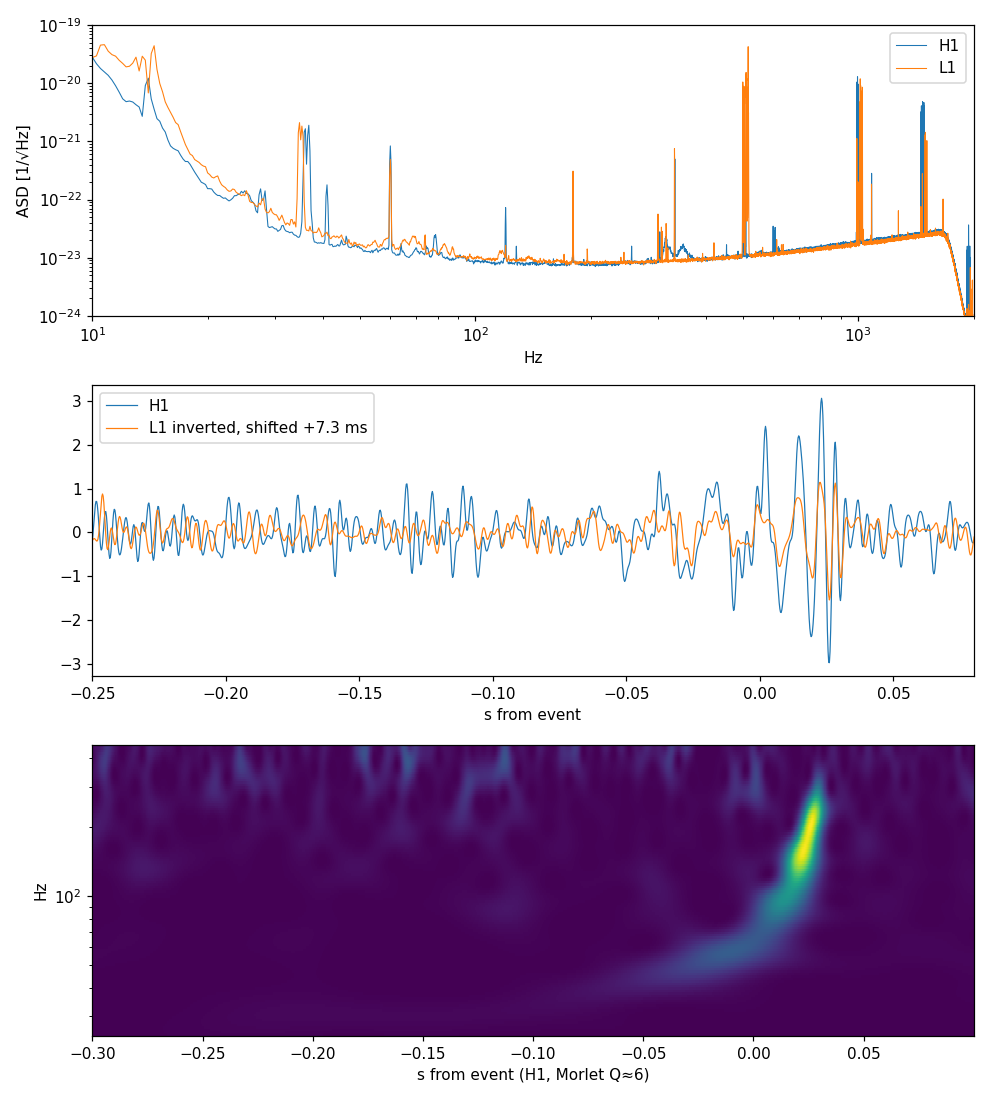
A signal buried deep in noise: reproducing the picture of the first gravitational-wave detection from public data
GW150914 from public LIGO data: why the first attempt failed, what the collaboration does with the noise, four properties of the signal compared with published values — and…
Lesen -
Bewertung der Grundlagen der bildgebenden Neurowissenschaft — Stand 9. Oktober 2026
Zwischenstand: Teil 1 abgeschlossen, Teile 2 und 3 eröffnet, eine Arbeit Schritt für Schritt zerlegt. Keine Schlussfolgerungen. [REVIEW NEEDED]
Lesen -
Summaries Lean
A finding retold loses its qualifications first — so retellings drift, and always toward the stronger claim. Including a lecture about exactly that, and including our own notes.
Lesen -
One Transform, Four Languages, Identical Bits
What it takes to call a numerical result canonical — and why a plausible average is the easiest way to be wrong.
Lesen -
What a Tumbling Satellite Reveals About Itself
A spacecraft's own wobble carries its mass distribution. Prediction meets measurement at 0.13 of an FFT bin.
Lesen -
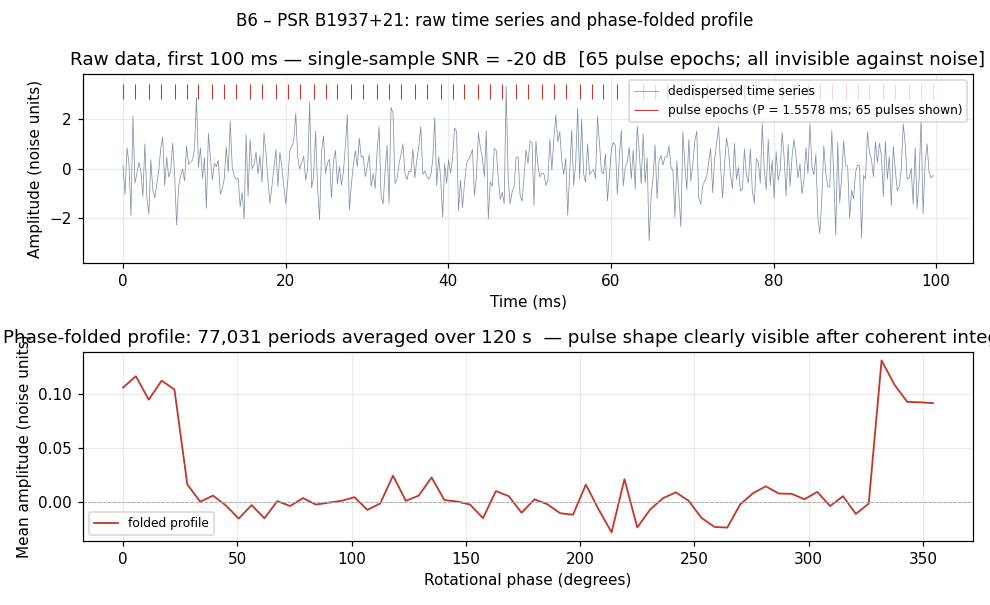
Listening to the Cosmos: How the Fourier Transform Finds a Pulsar 11,750 Light-Years Away
In 1932 an engineer found the galaxy was broadcasting. Fifty years later the same mathematics pulled a binary pulsar out of noise.
Lesen -
The Noise That Knows Itself: What a Nuclear Reactor Broadcasts When Nobody Is Listening
Three independent methods, three different numbers, one honest conclusion — what reactor noise teaches about the limits of a single measurement.
Lesen -
When Does a Spinning Thing Stop Being Predictable?
Determinism is not foreknowledge. A tumbling body is the cleanest place to watch the difference open up.
Lesen